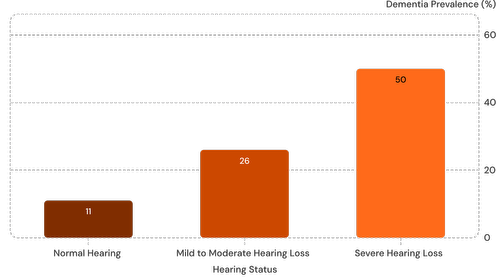
Far from being a harmless side effect of aging, age-related auditory decline is a critical public health concern. According to the landmark 2024 Lancet Commission report, approximately 7% of global dementia cases stem directly from hearing impairment, positioning it among the most influential modifiable risk factors for cognitive decline. Research from The Chinese University of Hong Kong establishes a definitive link between the escalation of hearing loss and rising dementia vulnerability. Clinical data illustrates a stark gradient:
Among older adults with unimpaired hearing, the prevalence of dementia sits at 11%.
For individuals grappling with mild-to-moderate hearing impairment, that figure surges to 26%.
Among those with severe hearing impairment, a staggering 50% concurrently suffer from dementia.
Equally alarming is a hidden diagnostic gap: comprehensive clinical evaluations reveal that 77% of dementia patients who initially self-reported normal hearing actually harbored measurable auditory deficits. Nearly half of these overlooked instances (47%) proved severe enough to necessitate immediate hearing aid intervention.
🧠 Unpacking the Neurological Link: Three Mechanisms Connecting Hearing Loss to Dementia
Clinical evidence indicates that every 10-decibel decline in hearing escalates dementia risk by 16%. Neuroscientists and audiologists trace this causal nexus to three distinct pathways:
The Sensory Deprivation Hypothesis: Diminished auditory stimulation starves the central nervous system of input, driving brain volume shrinkage and neural degeneration that impairs overarching cognitive processing. Timely acoustic rehabilitation via hearing aids restores vital neural input before irreversible deprivation occurs, helping to preserve neurological structure and buffer against cognitive erosion.
Cognitive Overload: When the brain must constantly strain to decode fragmented speech, it exhausts finite neural bandwidth. This leaves insufficient cognitive reserves for higher-order executive functions, such as working memory and abstract reasoning. Effective auditory management mitigates this extraneous mental exhaustion, liberating valuable cognitive resources for everyday tasks.
Social Isolation: Unaddressed hearing loss frequently drives individuals away from meaningful interactions with loved ones, outdoor outings, and community engagement. Such prolonged social withdrawal is strongly correlated with an elevated risk of cognitive decline. Restoring clear communication through appropriate hearing technology revitalizes social connectivity, acting as a powerful safeguard against dementia.
🦻 Hearing Aids: A Viable Shield Against Cognitive Decline
Intervening early to treat hearing loss can profoundly safeguard cognitive longevity. A robust, large-scale collaborative investigation by the University of Hong Kong alongside international institutions—evaluating over 61,000 adults aged 55 and older—uncovered compelling findings:
Individuals utilizing hearing aids exhibited a 9% reduction in suspected dementia risk compared to non-users.
This protective shield depends heavily on functional efficacy: patients who achieved optimal auditory enhancement through well-fitted devices realized a 14% drop in dementia risk.
Conversely, individuals wearing poorly calibrated or ineffective devices derived no statistically significant protective benefit.
🎯 Who Should Prioritize Hearing Screenings? The World Health Organization (WHO) outlines clear criteria for proactive auditory evaluations:
Adults Aged 50 and Older: Routine clinical checks initiated at age 50 are vital for detecting early, asymptomatic hearing deterioration.
High-Risk Populations: Individuals managing hypertension, diabetes, pre-existing cognitive concerns, or a documented history of chronic noise exposure.
Symptomatic Individuals: Anyone experiencing auditory fatigue—such as hearing sounds without comprehending words, frequently requesting repetition, or turning the television volume to disruptive levels.
Protecting your brain health begins with safeguarding your hearing. Proactively addressing hearing issues not only allows you to rediscover the joy of hearing the wonderful sounds of the world, but also helps you maintain an active social life with your family, enjoying a confident, healthy, and high-quality golden era of life.
References:
Livingston, G., et al. (2024). Dementia prevention, intervention, and care: 2024 report of the Lancet standing Commission. The Lancet Commissions, 404(10452), 572–628.
Chang, W. T., et al. (2022). Targeted Screening in Older Adults: Hearing Loss and Mild Cognitive Impaired. J Community Med Public Health, 6: 269.
Yu, R. C., et al. (2024). Adult-onset hearing loss and incident cognitive impairment and dementia – A systematic review and meta-analysis of cohort studies. Ageing Research Reviews, 98, 10236.
Jiang, et al. (2026). Hearing aid effectiveness and probable dementia risk across 33 countries: A pooled analysis of seven cohorts. Cell Reports Medicine, 7, 102802.
World Health Organization. (2021). WHO Hearing Screening: Considerations for Implementation.
The content of this article is for reference only and does not constitute final diagnostic or treatment advice.