Success Rate

Understand Our Success Rates

Success rates provide valuable insights into each couple's unique situation. Through detailed data analysis, we can offer personalised treatment plans that help couples navigate their fertility journey with confidence.
How Do We Calculate Pregnancy Success Rates?
Clinical Pregnancy Rates (CPR) is Essential

CPR is confirmed through ultrasound examinations. A pregnancy is considered successful only when one or more gestational sacs are detected following embryo implantation. This method effectively eliminates the interference of early pregnancy tests, providing you with a clearer understanding of your treatment results.


Overview of Clinical Pregnancy Rates

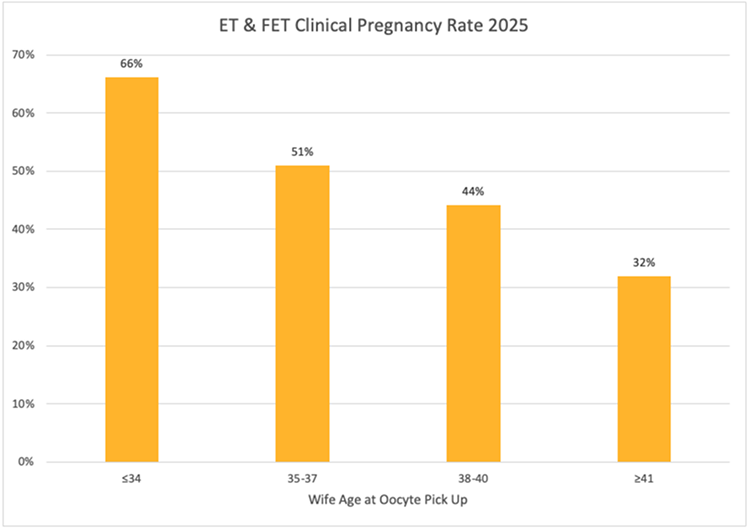
1. Clinical Pregnancy Rate of In-vitro Fertilization (IVF) - Embryo Transfer (ET) and Frozen Embryo Transfer (FET)

In women undergoing IVF treatment, more eggs can be obtained and developed into embryos, usually 1-3 embryos will be selected for transfer. The surplus embryos may be frozen for replacement in a subsequent stage.

In 2025, our overall success rate for fresh and frozen embryo transfers was 51%. Success rates were 66% for women aged 34 and under, and 32% for women over 41. These results help us tailor guidance and treatment planning to better match the needs and clinical profiles of different age groups.

* Not all IVF cases have suitable embryos for transfer.


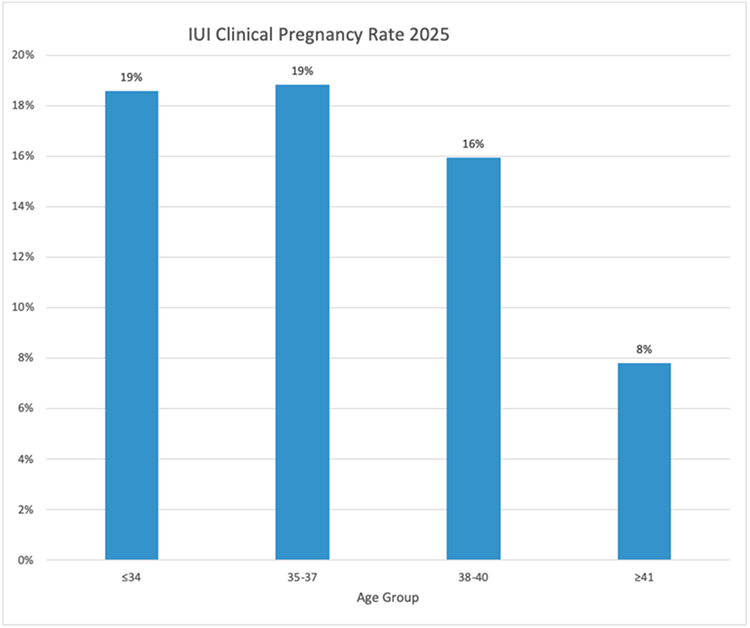
2. Clinical Pregnancy Rate of Intrauterine Insemination (IUI)

In 2025, our IUI success rate stood at 17%. Women aged 34 and under achieved an 19% success rate, whereas those over 41 had a success rate of 8%. These statistics highlight the influence of age on fertility success, allowing us to provide better support.

Take-Home Baby Rate

The Take-Home Baby Rate is another vital indicator for assessing treatment effectiveness. Generally, CPR is higher than the Take-Home Baby Rate due to potential miscarriages or medical reasons leading to pregnancy termination during assisted reproductive treatments.

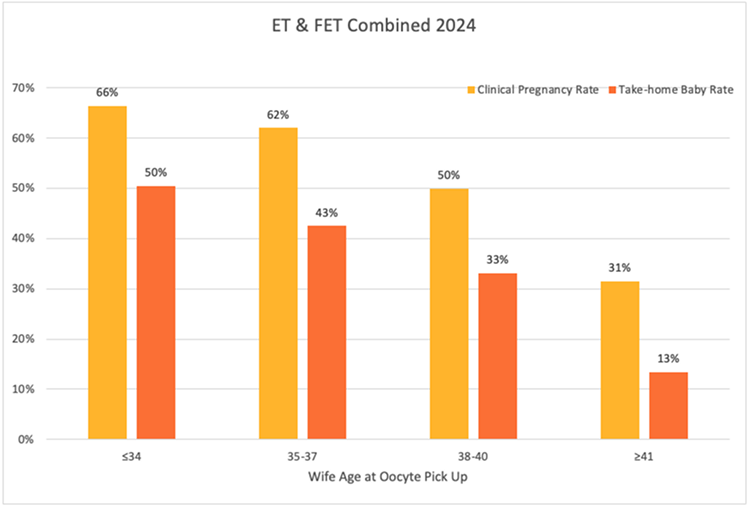
1. Take-home Baby Rate of In-vitro Fertilization (IVF) - Embryo Transfer (ET) and Frozen Embryo Transfer (FET)

In 2024, the overall take-home baby rate of ET and FET in our centre was 40%. The take-home baby rate of ET and FET of different age groups is as follows.

* 9 lost to follow up cases after clinical pregnancy


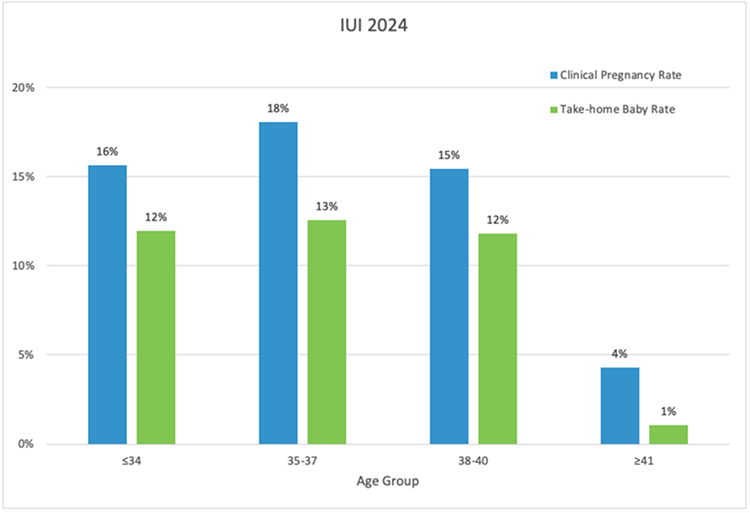
2. Take-home Baby Rate of Intrauterine Insemination (IUI)

In 2024, the overall take-home baby rate of IUI in our centre was 11%. The take-home baby rate of IUI of different age groups is as follows.

*7 lost to follow up case after clinical pregnancy

Other Information:

  1. Annual statistics from the Council on Human Reproductive Technology (Hong Kong)
Continuous Improvement Through Data Analysis

Our precise data collection system accurately records the results of each treatment cycle and undergoes regular analysis. This allows us to continually enhance our services and provide better support for every couple. We are dedicated to improving treatment outcomes to help you achieve your dream of parenthood.

Learn More About Our Services

If you are interested in our Clinical Pregnancy Rates, Take-Home Baby Rates, or other services, please do not hesitate to contact us. We look forward to helping you realise your dream of becoming a parent and bringing health and happiness to your family!

Icon Back To Top