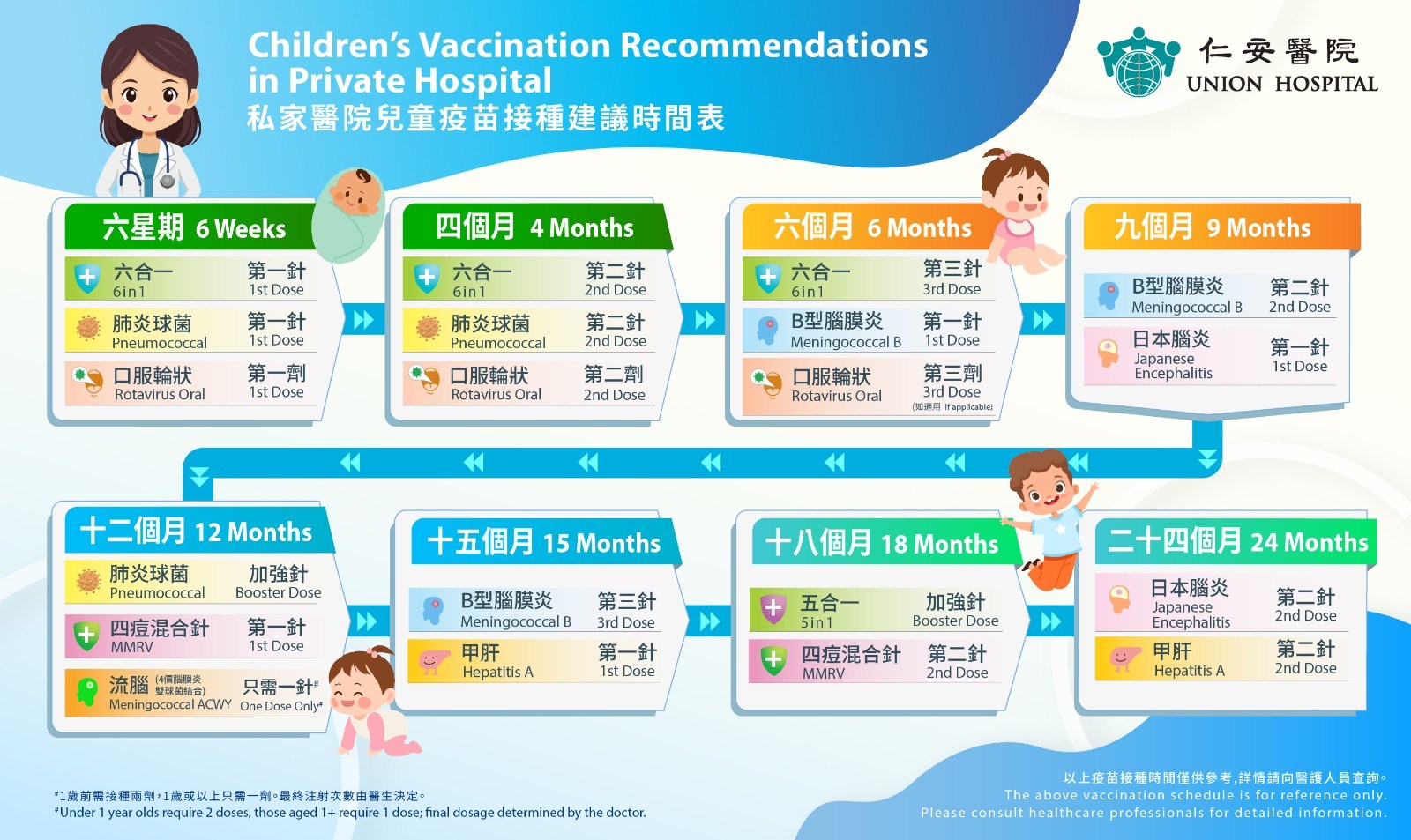
Vaccination is an important step in protecting children’s health. It helps the body build immunity and reduces the risk of infection and serious complications.
We provide a wide range of commonly used vaccines for children and adolescents. Our medical team will recommend a suitable vaccination arrangement based on your child’s age, health condition, previous vaccination record and travel needs.
The following vaccine information is for reference only. Actual vaccination must be subject to assessment by a paediatrician. Please contact our staff upon booking for details on vaccine fees, number of doses and injection arrangements.
Paediatric combination vaccines can protect against multiple common childhood infectious diseases in a single injection. They help reduce the number of injections required while supporting the development of immune protection. The doctor will recommend a suitable vaccine combination according to your child’s age, health condition and previous vaccination record. Common types include six-in-one, five-in-one, four-in-one and Hib vaccines.
| Vaccine Type | Six-in-One Vaccine | Five-in-One Vaccine | Four-in-One Vaccine | Hib Vaccine |
|---|---|---|---|---|
| Disease Covered |
|
|
| Haemophilus influenzae type b (Hib) infection |
| Eligible recipients | Infants and children, usually starting from around 6 weeks to 2 months of age, depending on the vaccine brand and previous vaccination record. | |||
| Interval |
| |||
| Route of administration | Intramuscular injection | |||
Hepatitis A is mainly transmitted through contaminated food or water. Children may not show obvious symptoms after infection, but they may still spread the virus to others. Vaccination helps reduce the risk of infection and hepatitis-related complications.
Eligible recipients
Children and adolescents; particularly suitable for children who are preparing to travel, frequently dine out, or wish to receive additional protection.
Number of doses
2 doses
Interval
The 2nd dose is usually given 6 to 12 months after the 1st dose.
Route of administration
Intramuscular injection
Hepatitis B can be transmitted through blood or body fluids, and can also be passed from mother to baby during delivery. Completing the Hepatitis B vaccination course helps reduce the risk of infection and chronic liver disease in later life.
Eligible recipients
Newborns, children and individuals who have not completed Hepatitis B vaccination.
Number of doses
Usually 3 doses
Interval
Commonly given at birth, 1 month and 6 months of age. Catch-up vaccination will be arranged according to medical assessment.
Route of administration
Intramuscular injection
Japanese encephalitis is transmitted through the bite of infected mosquitoes. Although the local risk in Hong Kong is relatively low, children travelling to areas where Japanese encephalitis is endemic, or staying for an extended period in rural or agricultural areas, may consider vaccination for additional protection.
Eligible recipients
Children and adults aged 9 months or above; particularly suitable for those travelling to high-risk areas or staying there for an extended period.
Number of doses
Usually 1 dose. For children and adolescents who require long-term protection, the doctor may recommend a booster dose.
Interval
If a booster dose is required, it is usually arranged around 1 to 2 years after the 1st dose, depending on the ongoing risk of exposure.
Route of administration
Subcutaneous injection
The MMRV vaccine* helps protect against measles, mumps, rubella and varicella. These diseases may cause fever, rash and swelling of the parotid glands. In severe cases, they may lead to pneumonia, encephalitis or other complications.
We also provide the MMR vaccine, which protects against measles, mumps and rubella.
Eligible recipients
Children and individuals who have not completed vaccination; generally starting from 12 months of age.
Number of doses
Usually 2 doses
Interval
Under the Hong Kong Childhood Immunisation Programme, related vaccinations are generally arranged at 12 months and 18 months / Primary One stage. The actual arrangement depends on the child’s year of birth and vaccination record.
Route of administration
Subcutaneous injection
*Under the Hong Kong Childhood Immunisation Programme, children born on or after 1 July 2018 will receive the Measles, Mumps, Rubella & Varicella (MMRV) vaccine at 18 months of age.

Rotavirus is a common cause of gastroenteritis in infants and young children. It can cause severe diarrhoea, vomiting, fever and dehydration. The rotavirus vaccine is an oral vaccine suitable for infants in early infancy.
| Vaccine | Rotarix | RotaTeq |
|---|---|---|
| Eligible recipients | Infants, usually starting from 6 weeks of age | Infants, usually starting from 6 to 12 weeks of age |
| Number of doses | 2 doses | 3 doses |
| Interval | At least 4 weeks between doses; the course should be completed before 24 months of age | Around 4 to 10 weeks between doses; the course should be completed before 32 months of age |
| Route of administration | Oral | |
Varicella, commonly known as chickenpox, is highly contagious and can cause fever and a generalised blister-like rash. Most children recover naturally, but some cases may develop complications such as skin infection, pneumonia or encephalitis. The varicella vaccine helps reduce the risk of infection and severe disease.
Eligible recipients
Children aged 12 months or above, and individuals who have never had chickenpox or have not completed vaccination.
Number of doses
Usually 2 doses
Interval
For children, the doses are usually given at least 3 months apart. For older children, the schedule may be arranged according to the doctor’s recommendation.
Route of administration
Subcutaneous injection
Note: The Hong Kong Childhood Immunisation Programme includes the varicella vaccine, with varicella or MMRV combined vaccination arranged at specified ages.
Meningococcal infection can cause meningitis and septicaemia, and the condition may deteriorate rapidly. The vaccine helps protect against meningococcal groups A, C, W and Y. It may be considered for individuals with travel, overseas study, dormitory living or other high-risk factors.
| Vaccine | Nimenrix | MenQuadfi |
|---|---|---|
| Eligible recipients | Infants, children, and adolescents aged 6 weeks or above | Infants, children, and adolescents aged 1 year or above |
| Number of doses | 6 weeks to 5 months: 3 doses 6 months to 11 months: 2 doses 1 year or above: 1 dose | 1 dose |
| Interval | Primary infant doses are usually given around 2 months apart; booster dose is usually arranged at or after 12 months of age | Not applicable |
| Route of administration | Intramuscular injection | |
Meningococcal group B can cause invasive meningococcal disease, including meningitis and septicaemia. Bexsero may be used to help protect against meningococcal group B infection, and may be considered especially for infants, young children, adolescents, overseas students or individuals at higher risk of infection.
Eligible recipients
Infants, children and adolescents aged 2 months or above.
Number of doses
2 to 23 months: 3 doses
2 years or above: 2 doses
* According to official recommendations, booster doses should be considered for individuals with ongoing risk of meningococcal infection.
Interval
No less than 2 months
Route of administration
Intramuscular injection
Pneumococcus can cause otitis media, pneumonia, meningitis and septicaemia. Infants, young children, older adults and immunocompromised individuals are at higher risk. Pneumococcal conjugate vaccines help children build protection and reduce the risk of serious infection.
| Vaccine | PCV20 | PCV15 |
|---|---|---|
| Eligible recipients | Infants, children, and adolescents aged 6 weeks or above | Infants, children, and adolescents aged 1 year or above |
| Serotype coverage | 20 serotypes Provides 5 additional serotypes compared with PCV15: 8, 10A, 11A, 12F, 15B | 15 serotypes |
| Number of doses | Newborn infants starting from 2 months: 4 doses Unvaccinated infants aged 7 - 11 months: 3 doses Catch-up vaccination for toddlers aged 12 - 23 months: 2 doses Children/adolescents aged 2 to 17 years: 1 dose | Infants aged 2 to 11 months: 3 doses Catch-up vaccination for toddlers aged 12 to 23 months: 2doses Children/adolescents aged 2 to 17 years: 1 dose |
| Interval | Common schedule: 2, 4, 6 and 12 months of age | Common schedule: 2, 4 and 12 months of age (the first two doses should be at least 2 months apart) |
| Route of administration | Intramuscular injection | Intramuscular injection |
Seasonal influenza can cause fever, cough, sore throat, muscle pain and fatigue. Children infected with influenza may develop complications such as otitis media, pneumonia or other conditions. Annual influenza vaccination helps reduce the risk of infection, severe disease and hospitalisation.
Eligible recipients
Children and adults aged 6 months or above; especially recommended for young children, students, individuals with chronic illnesses or those with weakened immunity.
Number of doses
1 dose every year. Children under 9 years old who are receiving the vaccine for the first time or have incomplete vaccination records may require 2 doses.
Interval
If 2 doses are required, they should be given at least 4 weeks apart.
Route of administration
Intramuscular injection or nasal spray vaccine, subject to doctor’s assessment.
Our four paediatric vaccination plans meet the practical needs of different families. Parents may flexibly choose the most suitable plan according to their child’s age, health condition and previous vaccination record. Every vaccination is carefully assessed and arranged by a paediatric specialist, ensuring that babies receive appropriate immune protection in a safe and comfortable environment.
Comprehensive Plan
✨ The broadest and most comprehensive vaccine coverage, offering one-stop protection for greater peace of mind.
Essential Protection Plan
✨ Focuses on essential basic protection, offering a cost-effective option with the flexibility to add individual vaccines as needed.
Maternal and Child Health Centre Supplementary Plan
✨ Precisely supplements key vaccines not covered by the government programme, such as rotavirus and Haemophilus influenzae type B, while aligning seamlessly with the government vaccination schedule for more comprehensive protection.
Brain Protection Plan
✨ Focuses on protection against potentially life-threatening threats such as meningococcal and pneumococcal infections, building a stronger protective shield for brain health.
Before vaccination, a paediatric specialist will conduct a comprehensive clinical assessment to ensure that your baby is in a suitable condition to receive the vaccine.
Strict vaccine cold-chain management is in place to ensure vaccine potency and safety. Our hospital environment is warm and comfortable, helping reduce children’s fear of injections.
Our professional team assists in following up the vaccination schedule and provides clear vaccination records, helping ensure no dose is missed.
You are welcome to book a paediatric vaccination consultation. The doctor will recommend a suitable vaccine combination and schedule based on your child’s age, health condition, vaccination record and travel needs.
2/F, Medical Centre, Union Hospital, 18 Fu Kin Street, Tai Wai, New Territories
Service Hours:
Monday to Saturday: 9:00 - 18:00
Sunday and Public Holiday: Closed
Shop G-3, 52-54 & 69-70, G/F, MOSTown Street, 8 On Shing Street, Ma On Shan, New Territories
Service Hours:
Monday to Friday: 10:00 - 19:00
Saturday: 9:00 - 18:00
Sunday and Public Holiday: Closed
Shop 101 & 102, Level 1 MCP Discovery, 8 Mau Yip Road, Tseung Kwan O, New Territories
Service Hours:
Monday to Friday: 10:00 - 19:00
Saturday: 9:00 - 18:00
Sunday and Public Holiday: Closed
Unit 3008-10 & 3011B, 3/F, KOLOUR - Tsuen Wan I, 68 Chung On Street, Tsuen Wan, New Territories
Service Hours:
Monday - Friday: 10:00am - 7:00pm
Saturday: 9:00am - 6:00pm
Sunday and Public Holiday: Closed
A: Vaccination helps children build immunity and reduces the risk of infection from various infectious diseases and serious complications, such as pneumonia, meningitis, otitis media, severe gastroenteritis and chronic liver disease. Following the Hong Kong Childhood Immunisation Programme helps provide children with more comprehensive protection.
A: The doctor will refer to the Hong Kong Childhood Immunisation Programme, as well as your child’s age, health condition, previous vaccination record and travel needs, to recommend suitable vaccines and vaccination timing. Parents are advised to bring their child’s immunisation record when attending the consultation, so that the doctor can make an accurate assessment.
A: Government-funded vaccines are mainly provided under the Hong Kong Childhood Immunisation Programme. They cover a range of important vaccines and are usually administered at Maternal and Child Health Centres or by school immunisation teams. Private hospitals can provide various combination vaccines, such as 6-in-1 and 5-in-1S vaccines, as well as additional self-financed vaccines, such as rotavirus, Hib, meningococcal, Japanese encephalitis and Hepatitis A vaccines. This allows parents to complete multiple vaccinations at the same institution. Parents are advised to discuss with the doctor to choose a suitable arrangement based on family needs and travel plans.
Most children experience only mild and short-term reactions after vaccination, such as:
In most cases, the child only needs adequate rest and fluids. Fever medication may be used if necessary, according to the doctor’s advice.
Seek medical attention immediately if any of the following occurs:
Yes. Even if a recommended vaccination time has been missed, most vaccines can still be given as catch-up doses. The doctor will arrange an appropriate schedule according to your child’s age and the number of doses already received, so that the vaccination course can be completed.
Combination vaccines can protect against multiple diseases in a single injection, such as six-in-one and five-in-one vaccines. Their benefits include:
The doctor will recommend combination or separate vaccination according to the vaccine brand, child’s age and family needs.
Additional vaccines may be recommended when travelling to certain regions or staying for a long period in rural or agricultural areas. Examples include:
The doctor will assess the need for additional vaccines according to the destination and duration of stay.
Vaccines work in different ways.